


Unpublished Flashcard
This flashcard is not publicly visible and is only accessible to admin users.
🇺🇸
Constitutional Law • Bills of Attainder
CONLAW#075
Legal Definition
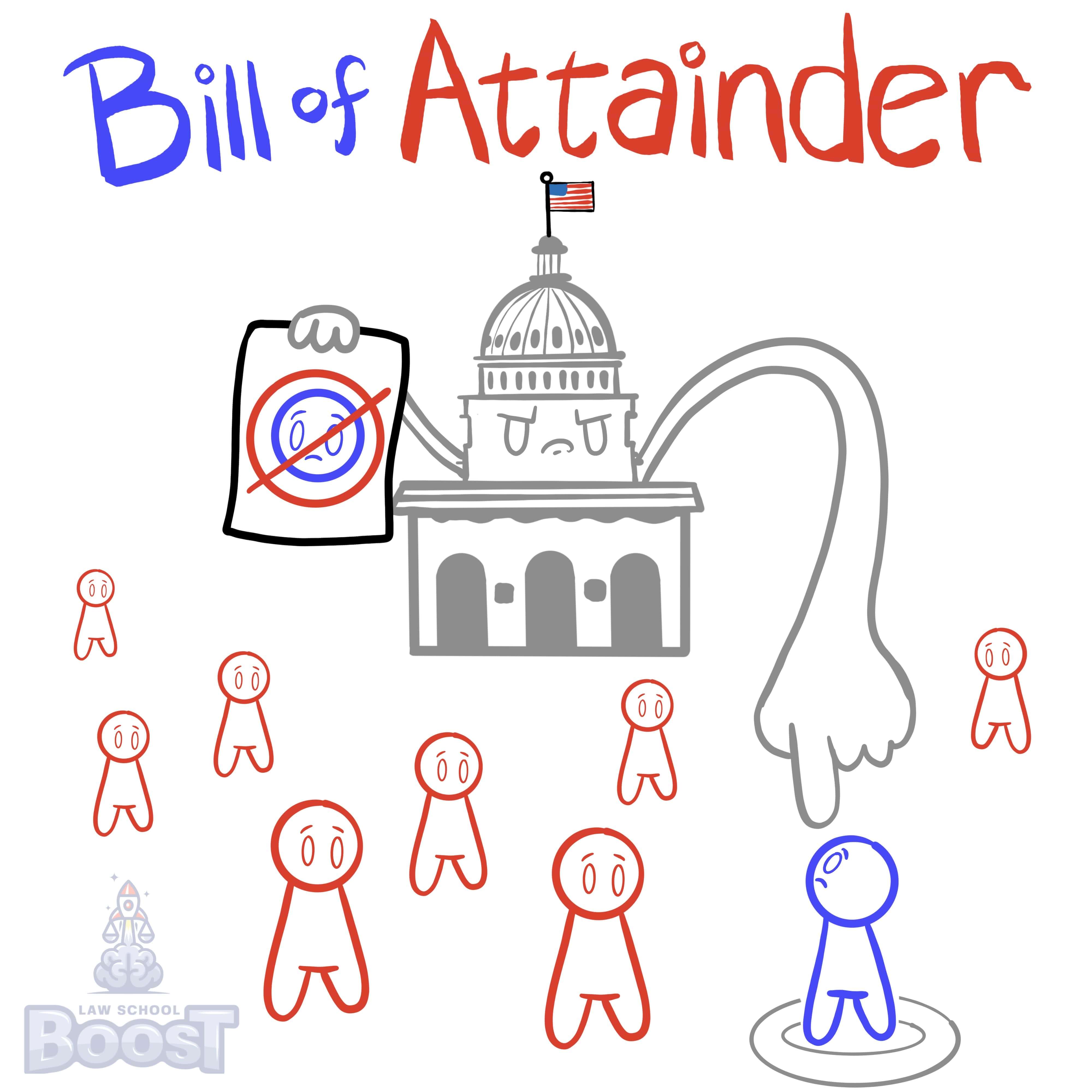
A bill of attainder is a law that directs punishment of a specific person or group without trial.
Plain English Explanation
First, let's make sense of the old-timey language being used for "bill of attainder." As you know, a "bill" is a proposed piece of legislation. "Attainder" is an antiquated legal term that refers to the extinction of civil rights that occurs when a person is sentenced to death or declared an outlaw. It comes from the root word "attainted," meaning "stained" or "corrupted." So, putting it together, a "bill of attainder" is a legislative act that inflicts the punishment of attainder (death or loss of rights) upon a person or group without first providing them a trial. The word "attainder" reflects how such laws would corruptly stain the accused without due process.
With that said, the government is prohibited from skipping the judicial process and unilaterally imposing punishment on people. Normally, the government has to take someone to court and prove they did something wrong before punishing them. Bills of attainder short-circuit this by allowing the legislature to simply pass a law declaring someone guilty and handing down punishment.
The purpose of banning bills of attainder is to uphold due process and the separation of powers. The legislature is not supposed to act as judge, jury, and executioner. That's the court's role. People are entitled to have a fair trial before being punished. Bills of attainder undermine this by allowing the legislature to hand down punishments on its own.
The ban prevents the government from arbitrarily or politically targeting people without proving anything. It forces the government to make its case in court under the standard rules of procedure and evidence. This ensures some basic fairness and protects unpopular individuals or groups from being railroaded. Overall, it maintains checks on government power.
With that said, the government is prohibited from skipping the judicial process and unilaterally imposing punishment on people. Normally, the government has to take someone to court and prove they did something wrong before punishing them. Bills of attainder short-circuit this by allowing the legislature to simply pass a law declaring someone guilty and handing down punishment.
The purpose of banning bills of attainder is to uphold due process and the separation of powers. The legislature is not supposed to act as judge, jury, and executioner. That's the court's role. People are entitled to have a fair trial before being punished. Bills of attainder undermine this by allowing the legislature to hand down punishments on its own.
The ban prevents the government from arbitrarily or politically targeting people without proving anything. It forces the government to make its case in court under the standard rules of procedure and evidence. This ensures some basic fairness and protects unpopular individuals or groups from being railroaded. Overall, it maintains checks on government power.
Hypothetical
Hypo 1: Hypofornia passes a law that specifically names Bob, stating he is guilty of tax evasion and must serve 5 years in prison, without giving Bob a chance to go to court. Result: This law is a bill of attainder because it punishes Bob without a trial, violating his right to due process.
Hypo 2: Hypofornia decides to target a group known as "The Hypo Environmentalists," accusing them of eco-terrorism through a law that imposes penalties on them specifically, without a trial. Result: This is considered a bill of attainder because it directly punishes a specific group without giving them a chance to defend themselves in a court of law.
Hypo 3: New Hypoland passes a law that all individuals convicted of burglary must serve a minimum of 10 years in prison. Bob, previously convicted of burglary, argues this is a bill of attainder against him. Result: This law is not a bill of attainder because it applies to anyone convicted of burglary, not just Bob, and it follows after a court conviction, not bypassing a trial.
Hypo 2: Hypofornia decides to target a group known as "The Hypo Environmentalists," accusing them of eco-terrorism through a law that imposes penalties on them specifically, without a trial. Result: This is considered a bill of attainder because it directly punishes a specific group without giving them a chance to defend themselves in a court of law.
Hypo 3: New Hypoland passes a law that all individuals convicted of burglary must serve a minimum of 10 years in prison. Bob, previously convicted of burglary, argues this is a bill of attainder against him. Result: This law is not a bill of attainder because it applies to anyone convicted of burglary, not just Bob, and it follows after a court conviction, not bypassing a trial.
Visual Aids