


🤝
Contracts • Formation Requirements
K#038
Legal Definition
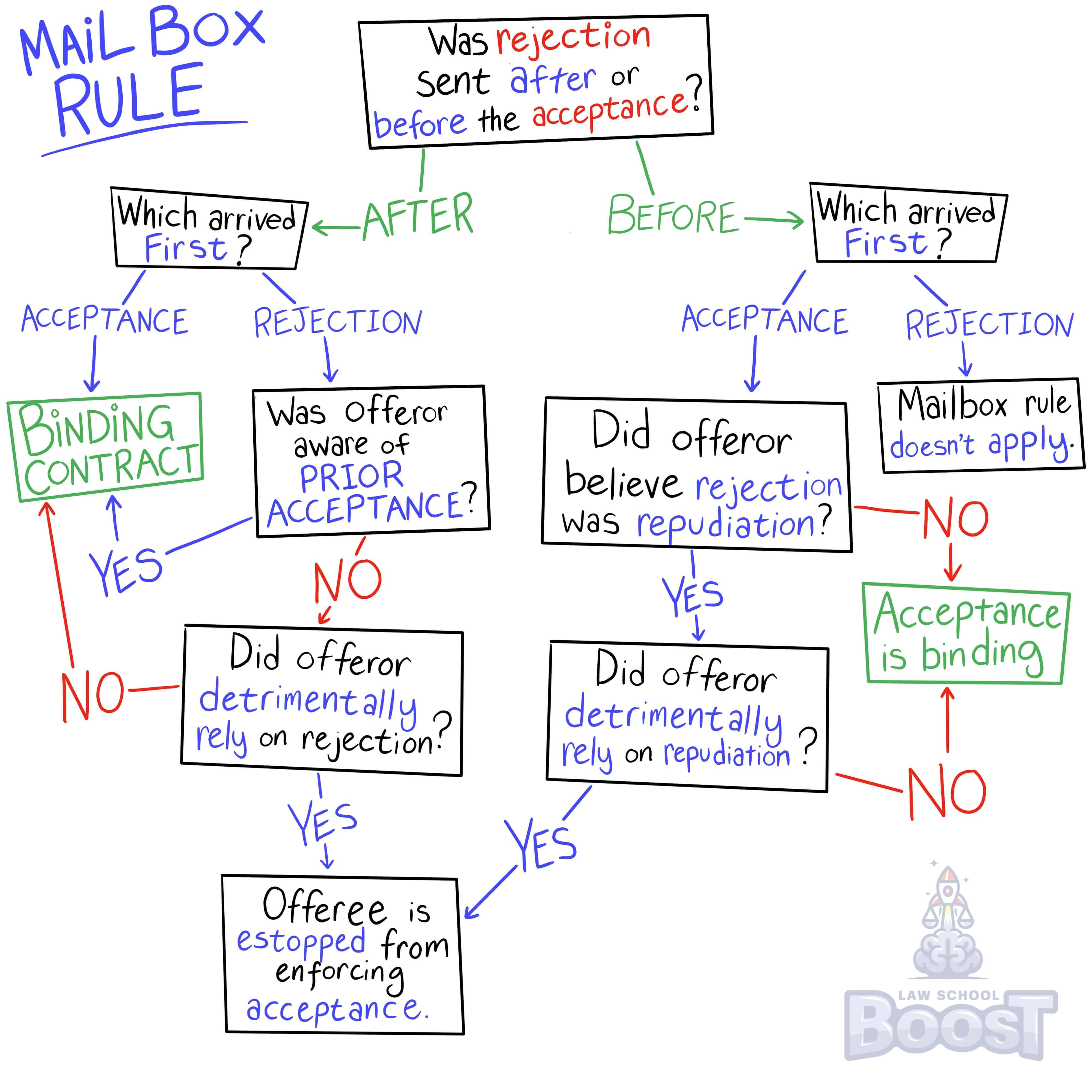
Under the Mailbox Rule, acceptances are generally effective when mailed. There are a couple exceptions: (1) where the acceptance is mailed after a rejection or revocation, then neither is effective until received by the other party; and (2) where the acceptance is mailed before the rejection, then the acceptance is effective if it arrives first and the offeror detrimentally relies on it. The mailbox rule is not applicable to option deadlines.
Plain English Explanation
The person who makes an offer (the "offeror") has all the power when it comes to the offer itself. All of its terms, how it can be accepted, when it can be accepted, what are the consequences of it being accepted, etc. The offeror even has the power to terminate an unaccepted offer, removing the power of acceptance from the offeree. However, once an offer is accepted--in fact, the moment that it is accepted, the offeror no longer has control over things like modifying the terms, or terminating the agreement. In other words, once an offer is accepted, it is no longer an offer, it is a binding, enforceable contract (this is a bit of an oversimplification, of course, since it requires other factors to be binding, like consideration... but for the sake of learning this rule, let's keep it simple).
With that in mind, we get to a very popular rule to be tested: the Mailbox Rule. Where many offers can be accepted immediately because the parties are in the same room, what happens when the parties are distances away? At what point is an offer truly accepted and binding if the acceptance is written on a piece of paper, put in an envelope, and placed into the mail? The answer: Under the Mailbox Rule, the acceptance is effective the moment it is placed into the mail as long as the offer hasn't been terminated by the offeror mailing notice of termination first.
When you get these types of questions on an exam, it will be pretty obvious because you'll see some sort of offer that is made, and then either a letter or fax machine used to respond. The best way to deal with these types of questions is to draw out a timeline on your exam paper and plot out who did what and when (like the illustration in the visualize section of this card).
With that in mind, we get to a very popular rule to be tested: the Mailbox Rule. Where many offers can be accepted immediately because the parties are in the same room, what happens when the parties are distances away? At what point is an offer truly accepted and binding if the acceptance is written on a piece of paper, put in an envelope, and placed into the mail? The answer: Under the Mailbox Rule, the acceptance is effective the moment it is placed into the mail as long as the offer hasn't been terminated by the offeror mailing notice of termination first.
When you get these types of questions on an exam, it will be pretty obvious because you'll see some sort of offer that is made, and then either a letter or fax machine used to respond. The best way to deal with these types of questions is to draw out a timeline on your exam paper and plot out who did what and when (like the illustration in the visualize section of this card).
Hypothetical
Hypo 1: On January 1, Bob mails Sam an offer. Sam receives the offer on January 3 and immediately sends a letter back accepting the offer. On January 4, Bob mails Sam notice that he is terminating his offer. On January 5, Bob receives Sam's acceptance. Result: Under the Mailbox Rule, Sam's acceptance is effective because it was mailed before Bob mailed his revocation.
Hypo 2: On January 1, Bob mails Sam an offer. On January 3 at 9am, Bob mails Sam a revocation. On January 3 at 3pm, Sam receives Bob's offer and immediately sends a letter accepting. On January 5, the postal worker delivers Sam's acceptance to Bob at 9am and Bob's revocation to Sam at 11am. Sam immediately opens the letter from Bob. Bob later checks his mail at 2pm and reads Sam's acceptance. Result: Because Bob mailed his revocation before Sam mailed his acceptance, neither is effective until it is received by the other party. Even though Sam's acceptance arrived in Bob's mailbox first, Bob didn't check his mail and receive it until after Sam had received the revocation. Thus, the offer was not effectively accepted because it was revoked before acceptance was received.
Hypo 3: On January 1, Bob mails Sam an offer. Sam receives the offer on January 3 and immediately sends a letter back rejecting the offer. On January 4, Sam changes his mind and sends an acceptance letter through expedited courier. On January 5, the courier arrives and hands the acceptance letter to Bob as he is walking to his mailbox. Bob is happy to see Sam accept, and is confused when he later finds a rejection letter in his mailbox. Result: Because the acceptance was received before the termination, the offer was effectively accepted.
Hypo 2: On January 1, Bob mails Sam an offer. On January 3 at 9am, Bob mails Sam a revocation. On January 3 at 3pm, Sam receives Bob's offer and immediately sends a letter accepting. On January 5, the postal worker delivers Sam's acceptance to Bob at 9am and Bob's revocation to Sam at 11am. Sam immediately opens the letter from Bob. Bob later checks his mail at 2pm and reads Sam's acceptance. Result: Because Bob mailed his revocation before Sam mailed his acceptance, neither is effective until it is received by the other party. Even though Sam's acceptance arrived in Bob's mailbox first, Bob didn't check his mail and receive it until after Sam had received the revocation. Thus, the offer was not effectively accepted because it was revoked before acceptance was received.
Hypo 3: On January 1, Bob mails Sam an offer. Sam receives the offer on January 3 and immediately sends a letter back rejecting the offer. On January 4, Sam changes his mind and sends an acceptance letter through expedited courier. On January 5, the courier arrives and hands the acceptance letter to Bob as he is walking to his mailbox. Bob is happy to see Sam accept, and is confused when he later finds a rejection letter in his mailbox. Result: Because the acceptance was received before the termination, the offer was effectively accepted.
Visual Aids