


Unpublished Flashcard
This flashcard is not publicly visible and is only accessible to admin users.
💰
Remedies • Tort - Equitable Remedies
REM#036
Legal Definition
The court has both civil and criminal contempt power to ensure compliance with court orders.
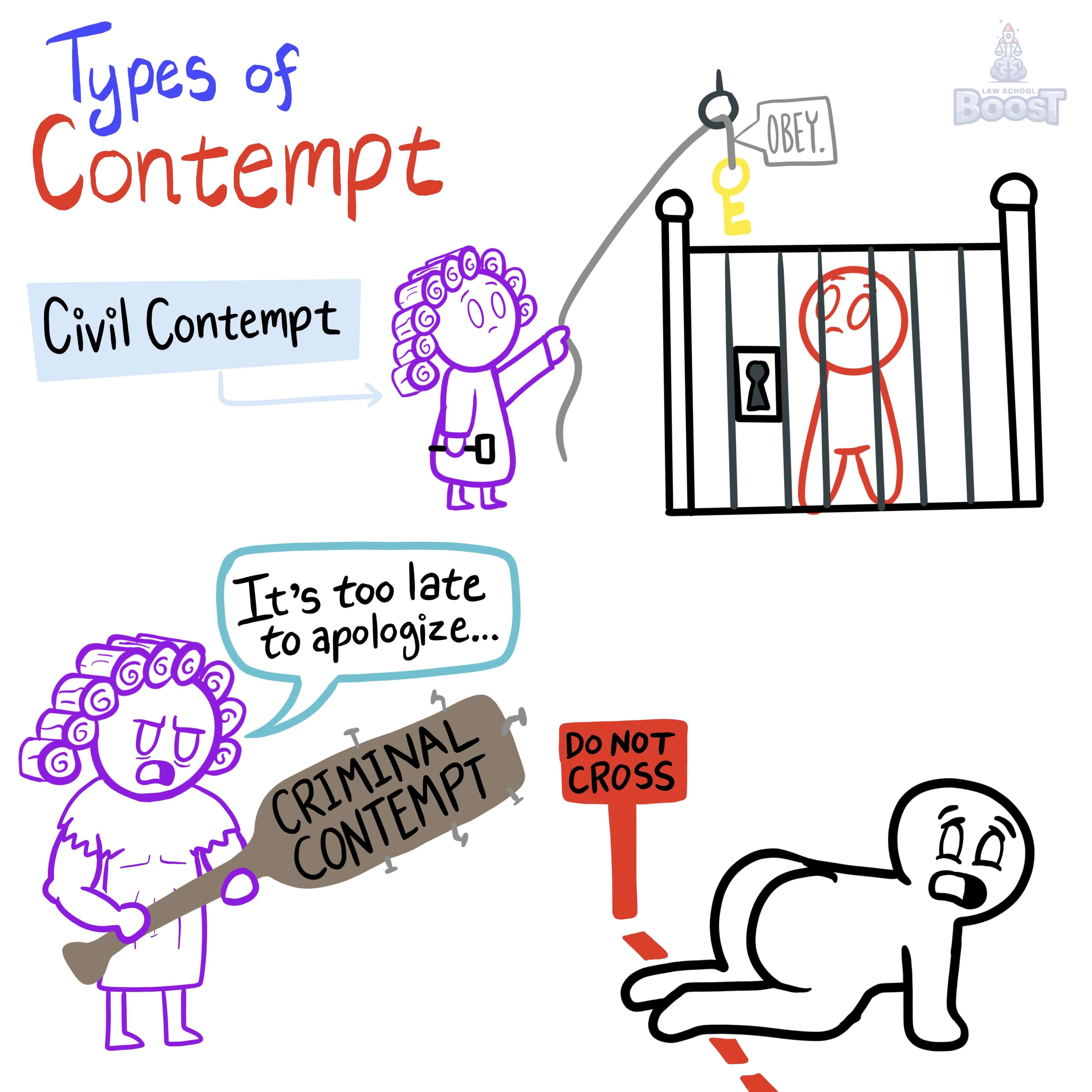
Civil contempt is intended to coerce, and includes monetary fines and imprisonment so long as the defendant holds the keys to the jailhouse (i.e., they can ensure their freedom by simply complying).
Criminal contempt is intended to punish, and also includes monetary fines and imprisonment, although the imprisoned defendant cannot get out for a given period of time.
Civil contempt is intended to coerce, and includes monetary fines and imprisonment so long as the defendant holds the keys to the jailhouse (i.e., they can ensure their freedom by simply complying).
Criminal contempt is intended to punish, and also includes monetary fines and imprisonment, although the imprisoned defendant cannot get out for a given period of time.
Plain English Explanation
Contempt is when someone disobeys or disrespects the court's orders. The court has two ways to deal with this: civil contempt and criminal contempt.
Civil contempt is like a warning. It's used to make someone follow the court's orders. If someone is found in civil contempt, they might have to pay money or even go to jail. But the catch is, they can get out of jail anytime they want by just doing what the court asked them to do in the first place. It's like if a teacher said, "You can leave when you finish your classwork." In this example, your are able to end your detention at any time by just doing your work.
Criminal contempt, on the other hand, is a punishment. It's for when someone seriously disrespects the court. If someone is found in criminal contempt, they might have to pay money or go to jail for a specific time, and they can't just get out whenever they want. It's like if a teacher said, "You're staying here for an hour, no matter what." Even if you finish your classwork, your detention isn't over until the time period expires.
The reason this rule exists is to make sure people respect and follow the court's decisions.
Civil contempt is like a warning. It's used to make someone follow the court's orders. If someone is found in civil contempt, they might have to pay money or even go to jail. But the catch is, they can get out of jail anytime they want by just doing what the court asked them to do in the first place. It's like if a teacher said, "You can leave when you finish your classwork." In this example, your are able to end your detention at any time by just doing your work.
Criminal contempt, on the other hand, is a punishment. It's for when someone seriously disrespects the court. If someone is found in criminal contempt, they might have to pay money or go to jail for a specific time, and they can't just get out whenever they want. It's like if a teacher said, "You're staying here for an hour, no matter what." Even if you finish your classwork, your detention isn't over until the time period expires.
The reason this rule exists is to make sure people respect and follow the court's decisions.
Hypothetical
Hypo 1: True story: H. Beatty Chadwick is recognized as the American record holder for the longest duration being held in civil contempt of court, with a staggering 14 years spent in prison. In 1995, a judge determined that Chadwick had concealed millions of U.S. dollars in foreign bank accounts to avoid paying the amount to his ex-wife during their divorce proceedings. As a result of the judge's ruling, Chadwick was imprisoned until he could produce $2.5 million for the Delaware County Court in Pennsylvania. Chadwick consistently argued that he had lost the money due to poor investments and, as such, couldn't hand over money he no longer had. On July 10, 2009, after 14 years of imprisonment, Chadwick was finally released. This decision was made by Delaware County Judge Joseph Cronin, who believed that further incarceration would no longer serve its intended purpose, as it was unlikely to compel Chadwick to produce the money.
Hypo 2: Bob borrows Sam's car and refuses to return it even after a court tells him to. Bob is found in civil contempt. Result: Bob is ordered to pay a fine every day until he returns the car. He can also be sent to jail but can get out anytime he returns the car to Sam.
Hypo 3: Bob shouts and disrupts the court proceedings when Sam is testifying against him. The judge finds Bob in criminal contempt. Result: Bob is fined and sent to jail for two weeks. He cannot get out early, even if he apologizes.
Hypo 2: Bob borrows Sam's car and refuses to return it even after a court tells him to. Bob is found in civil contempt. Result: Bob is ordered to pay a fine every day until he returns the car. He can also be sent to jail but can get out anytime he returns the car to Sam.
Hypo 3: Bob shouts and disrupts the court proceedings when Sam is testifying against him. The judge finds Bob in criminal contempt. Result: Bob is fined and sent to jail for two weeks. He cannot get out early, even if he apologizes.
Visual Aids