


Unpublished Flashcard
This flashcard is not publicly visible and is only accessible to admin users.
💀
Wills • Revocation
WILLS#026
Legal Definition
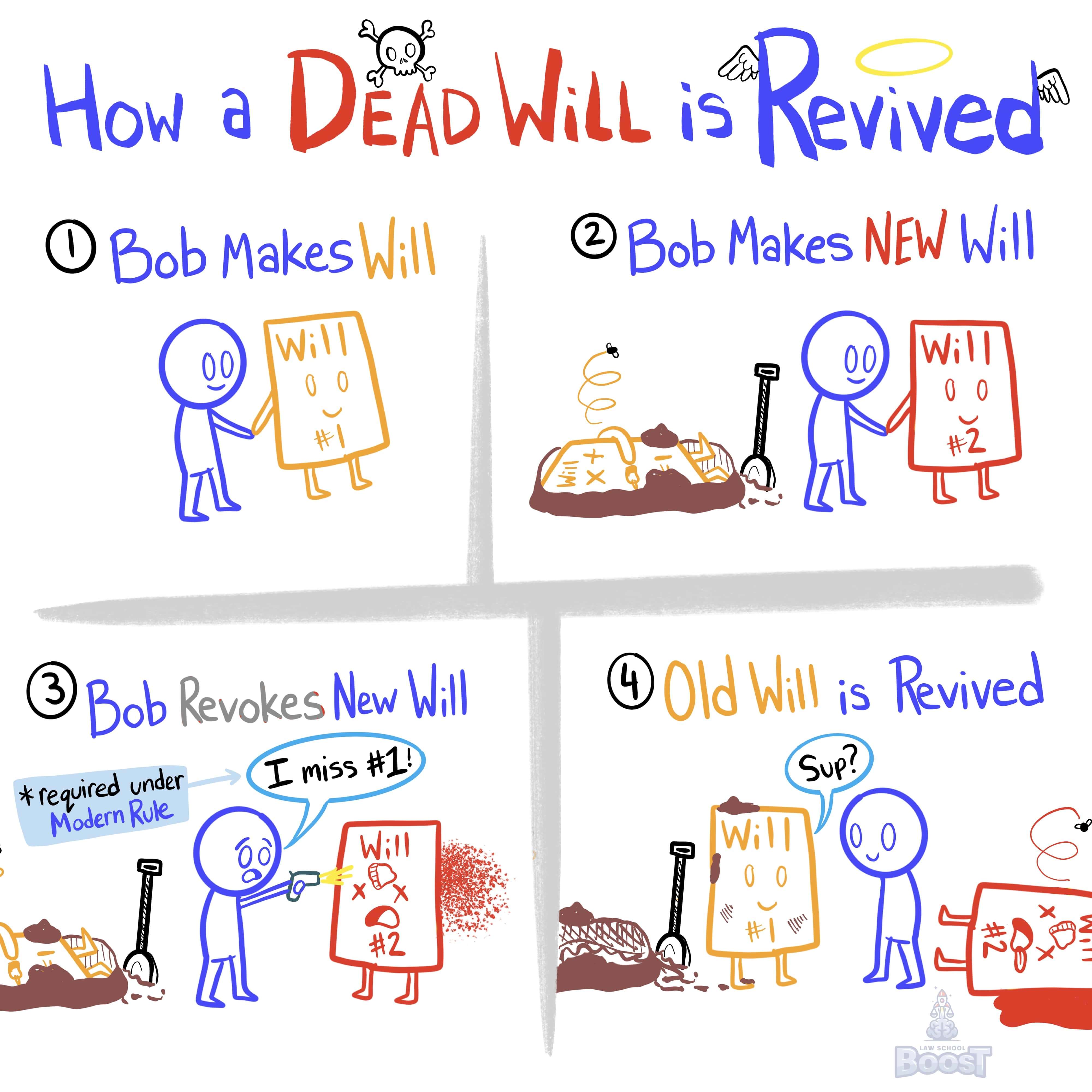
Revival allows a previously revoked will to be valid once again. Under the common law, a previous will is revived if the testator destroys a second will that revoked it prior to their death. Under the modern rule, a previous will is revived if there is evidence that the testator intended it to be revived after a later will was revoked.
Plain English Explanation
Sometimes people who create wills will update those wills over time. However, it isn't uncommon for someone to create a will and then, later, create an entirely new will that revokes the previous one. In certain circumstances, when the new will is also revoked, the previous will is un-revoked (revived).
Let's discuss those situations, but first let's start with a fact pattern that we will reuse for each situation: Imagine if Bob created Will #1 that left everything to Sam. Years later, Bob creates Will #2 that leaves everything to Amy and states that Will #1 is revoked. Years later, Bob changes his mind and burns Will #2. While burning Will #2, Bob catches on fire an dies. So what happens now? Who gets Bob's stuff? Amy or Sam?
(1) Under common law, Sam would get all of Bob's stuff. Why? The rationale is that since a will does not take effect until a person dies, Will #2 never went into effect, which means its clause that revoked Will #1 never happened. In other words, it's like Bob told Will #2 to kill Will #1 after he died, but then Bob decided to kill Will #2 first, leaving nothing to kill Will #1, which means Will #1 was the only thing left to go off of when Bob died. It was revived. Only a few states follow this rule.
(2) Most states follow a no-revival rule. In this situation, Will #2 is treated as a legal, immediate revocation of Will #1. Thus, when Bob later destroys Will #2 before death, he effectively has no valid will upon death, which means he died intestate.
(3) Both of the previous rules probably seem a bit unfulfilling and annoying. Because of that, a modern approach was created (Uniform Probate Code §2-509) to find compromise between them and has been adopted by some states, like California. Under the modern rule, the court tries to figure out whether the dead person intended to revive Will #1 when they destroyed Will #2. To do this, they will look at extrinsic evidence, like written or oral statements, as well as the circumstances surrounding the revocation of Will #1, to see if there is a compelling argument that the dead person would prefer Will #1 to be reinstated rather than die intestate.
Hypothetical
Hypo 1: Bob writes a will leaving everything to his friend Sam. Later, he writes a new will, leaving everything to his cousin. After a falling out with his cousin, Bob tears up the new will but doesn't write anything new. Result: Under the modern rule, if there's evidence that Bob wanted his first will (the one favoring Sam) to be in effect after destroying the second will, then the first will is revived and Sam will inherit.
Hypo 2: Sam is named in Bob's original will. Bob then makes a new will excluding Sam. However, Bob later verbally tells several friends that he regrets the change and wishes to go back to the original will, but he doesn't destroy the new will or write a new one. Result: Under the modern rule, the second will remains valid because Bob didn't revoke it. Even though he expressed a desire to revert to the original will, without revocation of the second will or clear evidence of revival, the first will remains inactive.
Hypo 3: Bob initially leaves his estate to a charity in his will. Later, he makes a new will leaving everything to Sam. Before his death, Bob loses the second will and tells his lawyer he wants to revert to the original will. Result: If evidence of Bob's intention to revert to the first will is found, like his statement to his lawyer, the first will can be revived under the modern rule, benefiting the charity.
Hypo 4: Bob writes a will leaving everything to Sam. Years later, he writes another will leaving everything to his neighbor. After Bob's passing, Sam finds the first will and destroys the second will himself, hoping to inherit. Result: The rule of revival doesn't apply here because Bob didn't revoke the second will himself. Sam's actions after Bob's death cannot revive the first will. The second will, if proven, remains valid.
Visual Aids