


🇺🇸
Constitutional Law • First Amendment - Free Speech
CONLAW#150
Legal Definition
1. Write your 1st Amendment free speech rule statement.
2. What is the actor seeking to restrict?
3. Who is restricting? If Private Party, then no protection. If Government, continue analysis.
4. What level of government? If Federal, 1st Amendment applies. If State, 1st Amendment applies through 14th Amendment.
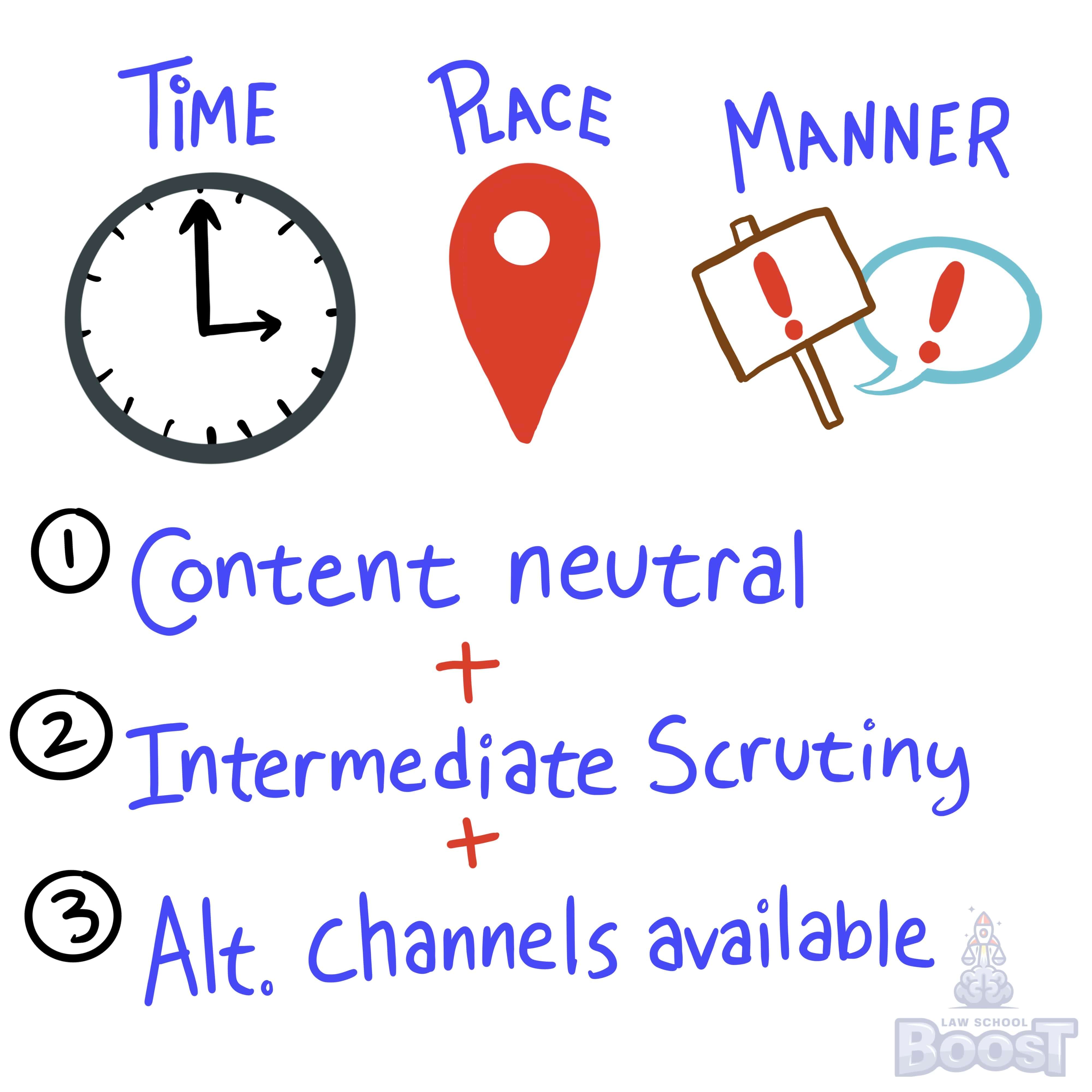
5. In what forum? If Public or Designated Public, then apply strict scrutiny unless Time, Place, Manner [TPM = (1) content-neutral; (2) important government purpose; (3) leaves open adequate alternatives (least restrictive)]. If Limited or Non-Public, then (1) view-point neutral and (2) rational basis test. If Private Property, then no right to access.
2. What is the actor seeking to restrict?
3. Who is restricting? If Private Party, then no protection. If Government, continue analysis.
4. What level of government? If Federal, 1st Amendment applies. If State, 1st Amendment applies through 14th Amendment.
5. In what forum? If Public or Designated Public, then apply strict scrutiny unless Time, Place, Manner [TPM = (1) content-neutral; (2) important government purpose; (3) leaves open adequate alternatives (least restrictive)]. If Limited or Non-Public, then (1) view-point neutral and (2) rational basis test. If Private Property, then no right to access.
Plain English Explanation
Imagine you came across this type of issue on an exam. These are the steps you should think through to address it.
(1) Start off with your rule statement. Something generic like "The First Amendment provides that Congress shall make no law abridging the freedoms of speech, press, association, and religion. The First Amendment is applied to the states via the 14th Amendment Due Process Clause (in other words, the First amendment is "incorporated" to apply to the states under the 14th Amendment Due Process Clause)." This can be tailored to the specifics of whatever issue you're responding to.
(2) Next, you need to figure out what exactly is attempting to be restricted. What made you realize "Oh, hey, this is a First Amendment issue!"?
(3) Who is attempting to restrict the speech? Remember, if its a private party, then the First Amendment doesn't apply. Walmart is allowed to tell you to leave their store because they don't like what you are saying. However, if the government is the one oppressing a voice, then keep working through the analysis.
(4) At this point, you've identified that the government is oppressing speech, but what level of government? If it's the Federal government, then all you have to do is state that the 1st Amendment applies. But if it's the State government, you need to make sure that you clarify that the 1st Amendment applies through the 14th Amendment.
(5) Identify in which area the speech is being oppressed so that we know which rules to apply to figure out if the government has crossed a line. Public spaces require strict scrutiny unless the restrictions are content-neutral + important to a government purpose + doesn't completely take away every ability for the speaker to get their message out in other ways. Limited or Non-Public forums require rules that are view-point neutral and pass the rational basis test. And, if private property, then of course you don't have rights under the 1st Amendment so go home.
(1) Start off with your rule statement. Something generic like "The First Amendment provides that Congress shall make no law abridging the freedoms of speech, press, association, and religion. The First Amendment is applied to the states via the 14th Amendment Due Process Clause (in other words, the First amendment is "incorporated" to apply to the states under the 14th Amendment Due Process Clause)." This can be tailored to the specifics of whatever issue you're responding to.
(2) Next, you need to figure out what exactly is attempting to be restricted. What made you realize "Oh, hey, this is a First Amendment issue!"?
(3) Who is attempting to restrict the speech? Remember, if its a private party, then the First Amendment doesn't apply. Walmart is allowed to tell you to leave their store because they don't like what you are saying. However, if the government is the one oppressing a voice, then keep working through the analysis.
(4) At this point, you've identified that the government is oppressing speech, but what level of government? If it's the Federal government, then all you have to do is state that the 1st Amendment applies. But if it's the State government, you need to make sure that you clarify that the 1st Amendment applies through the 14th Amendment.
(5) Identify in which area the speech is being oppressed so that we know which rules to apply to figure out if the government has crossed a line. Public spaces require strict scrutiny unless the restrictions are content-neutral + important to a government purpose + doesn't completely take away every ability for the speaker to get their message out in other ways. Limited or Non-Public forums require rules that are view-point neutral and pass the rational basis test. And, if private property, then of course you don't have rights under the 1st Amendment so go home.
Visual Aids