


🤝
Contracts • Terms of the Contract
K#087
Legal Definition
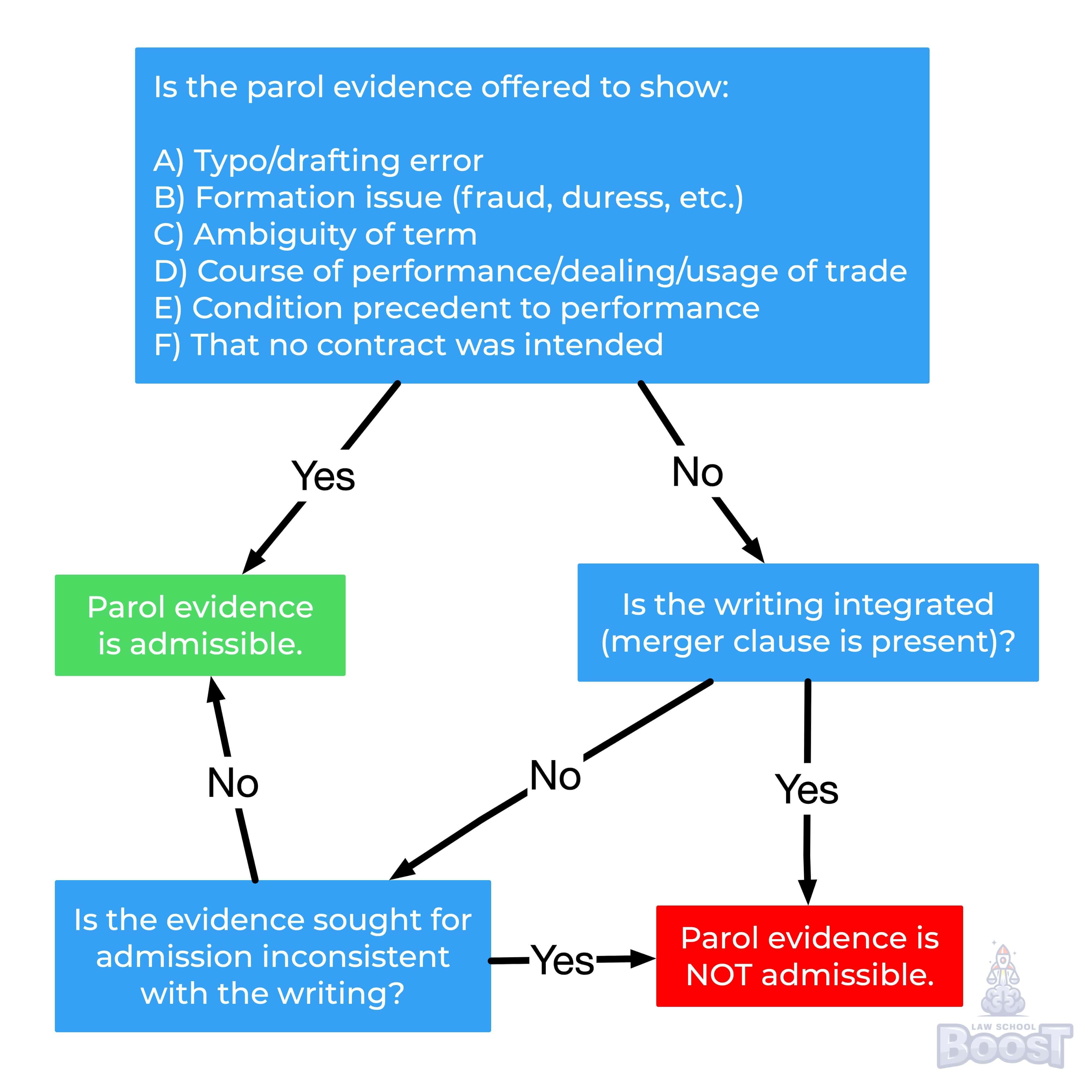
If a party claims that there was an oral agreement that the written contract would not become effective until a condition occurred, all evidence of such an agreement may be offered to the court.
Plain English Explanation
A "condition precedent" is a condition that must happen in order for a contract to be formed. In other words, if the required condition never happens, then the contract never forms. For example, if Sam tells Bob, "I'm going to go ahead and sign the contract, but let me ask my wife if she's okay with everything -- if she is, we're all set!" Even though Sam and Bob have a signed agreement, Sam's wife agreeing to the contract is a condition precedent that must first be satisfied in order to trigger a binding agreement.
Why is this important? Because the Parol Evidence Rule only applies to contracts that have been formed.
In other words, if a party is trying to offer parol evidence of an agreement where a condition needed to be satisfied in order for the contract to be valid, the Parol Evidence Rule will not block such evidence from being shown because if such a condition does exist, then the Parol Evidence Rule does not apply (since no contract was actually formed).
Why is this important? Because the Parol Evidence Rule only applies to contracts that have been formed.
In other words, if a party is trying to offer parol evidence of an agreement where a condition needed to be satisfied in order for the contract to be valid, the Parol Evidence Rule will not block such evidence from being shown because if such a condition does exist, then the Parol Evidence Rule does not apply (since no contract was actually formed).
Hypothetical
Hypo 1: Sam owns a taco cart. Bob wants Sam to cater his birthday party. Sam and Bob negotiate terms. Sam tells Bob, "I usually charge $200, but if you paint my house first, I'll cater your party for $50." Bob agrees. Sam and Bob then enter into a written contract that Sam will cater Bob's party for $50. Bob never paints Sam's house and sues Sam to force him to cater his birthday for $50. Result: Though the written contract only acknowledges part of the agreement between Bob and Sam, the full agreement included the condition precedent that Bob first paint Sam's house, which he failed to do. Since Bob failed to perform this condition, the contract was never formed and Sam can include parol evidence of the oral agreement in order to show the court that there was no breach.
Visual Aids