


Unpublished Flashcard
This flashcard is not publicly visible and is only accessible to admin users.
💰
Remedies • Contract - Legal Remedies
REM#002
Legal Definition
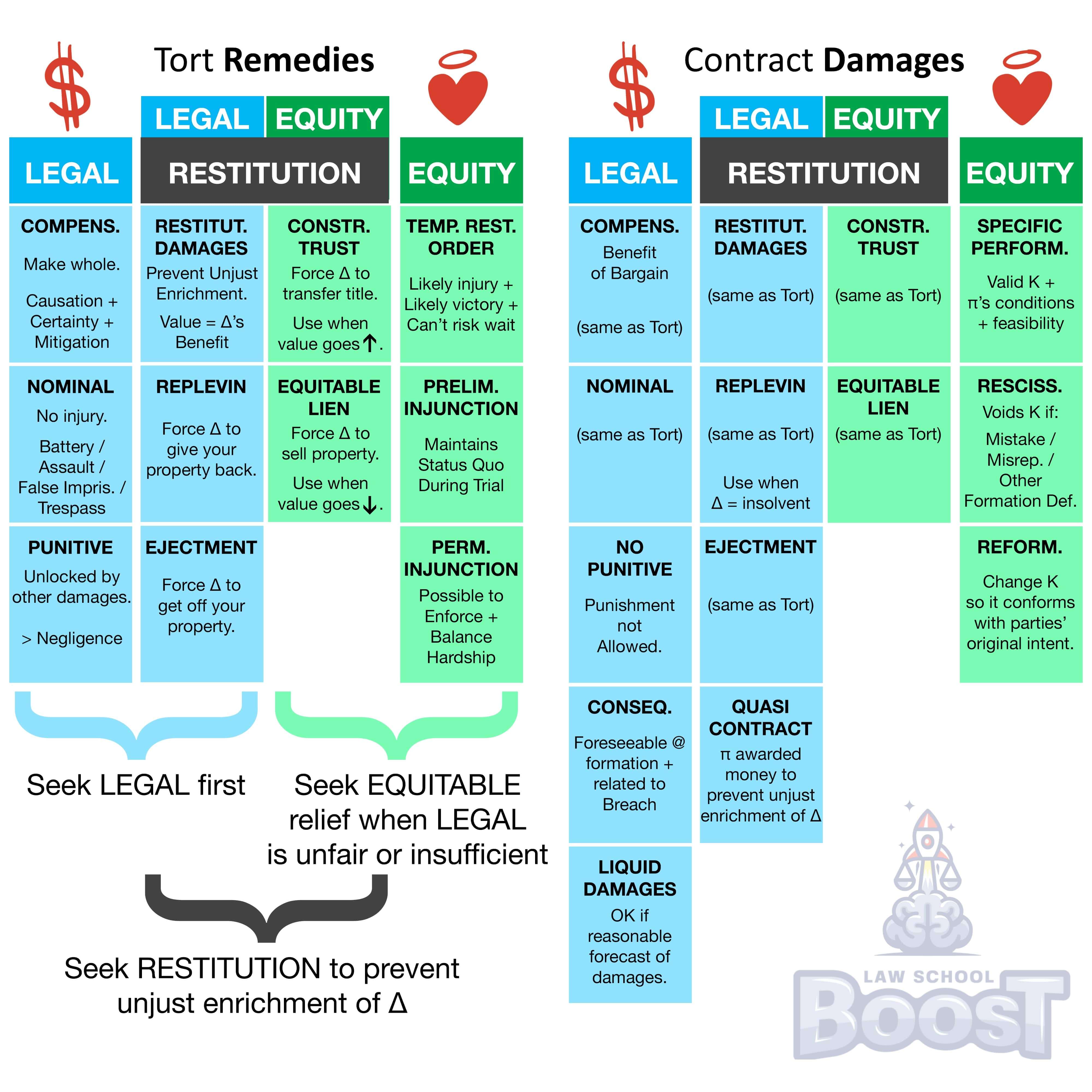
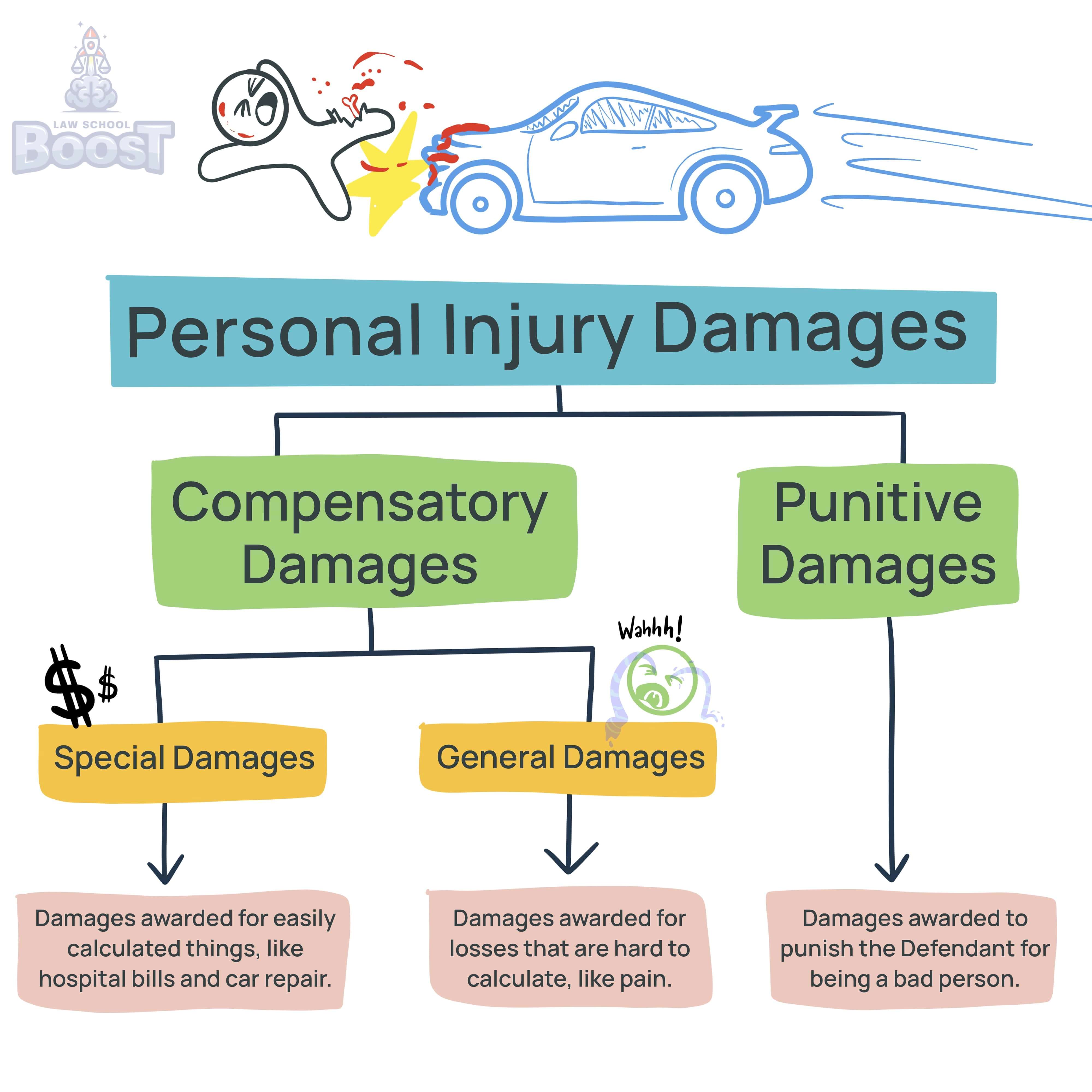
Compensatory damages are based on the amount of damage suffered by the plaintiff, and are intended to put the injured party in the position they would have been had the injury never occurred. To prove damages, there must be (1) causation, (2) foreseeability, (3) certainty, and (4) unavoidability.
Plain English Explanation
Compensatory damages compensate the victim for the harm they experienced with an amount of money that repairs the harm in a way that makes it as if the harm never happened in the first place. For example, if Bob breaks Sam's $50 sunglasses, Bob may have to compensate Sam $50 to replace the sunglasses.
To prove compensatory damages, a plaintiff will have to show that the harm was:
(1) Caused by the defendant's breach of duty. Use the "but for" test, meaning "but for the actions of the defendant, the harm would not have happened."
(2) Foreseeable, meaning that there is a reasonable argument (that you'll argue on the exam) that the type of harm the victim experienced was reasonably predictable based on the actions of the defendant. We cover this deeper in the Torts deck (CardID: TORT#027).
(3) Certain, meaning it actually happened, or certainly will happen. In other words, courts hate speculative damages which may happen in the future due to actions that occurred now. The more speculative, the harder it is to actually blame the defendant, and the less likely a court will make them compensate the plaintiff.
(4) Unavoidable, meaning that there was nothing the plaintiff could have done to either avoid the harm, or reduce the harm. Why? Because even though courts want to help victims recover, they don't want to support people letting themselves become victims when they had a chance to avoid getting harmed. For example, if someone gets their foot run over by a car, they should seek medical attention. If they fail to seek medical attention and their injury becomes more severe, even though the defendant is liable for running over the victim's foot, the court may not find them liable for the more severe injuries that were avoidable had the victim acted in a way that minimized the harm (like seeing a doctor).
To prove compensatory damages, a plaintiff will have to show that the harm was:
(1) Caused by the defendant's breach of duty. Use the "but for" test, meaning "but for the actions of the defendant, the harm would not have happened."
(2) Foreseeable, meaning that there is a reasonable argument (that you'll argue on the exam) that the type of harm the victim experienced was reasonably predictable based on the actions of the defendant. We cover this deeper in the Torts deck (CardID: TORT#027).
(3) Certain, meaning it actually happened, or certainly will happen. In other words, courts hate speculative damages which may happen in the future due to actions that occurred now. The more speculative, the harder it is to actually blame the defendant, and the less likely a court will make them compensate the plaintiff.
(4) Unavoidable, meaning that there was nothing the plaintiff could have done to either avoid the harm, or reduce the harm. Why? Because even though courts want to help victims recover, they don't want to support people letting themselves become victims when they had a chance to avoid getting harmed. For example, if someone gets their foot run over by a car, they should seek medical attention. If they fail to seek medical attention and their injury becomes more severe, even though the defendant is liable for running over the victim's foot, the court may not find them liable for the more severe injuries that were avoidable had the victim acted in a way that minimized the harm (like seeing a doctor).
Hypothetical
Hypo 1: Sam is driving recklessly through a stop sign and hits Bob who is riding his bike, breaking Bob's arm.
Result: Causation: Sam's reckless driving caused the accident. Foreseeability: It's foreseeable that reckless driving could hurt others. Certainty: Bob's medical costs and lost wages are calculable. Unavoidability: Bob could not avoid Sam's sudden reckless driving. Sam likely owes Bob compensatory damages.
Hypo 2: Bob asks Sam to stir vat of chocolate without safety gear. Sam slips on a spill and suffers severe burns. Result Causation: Bob's negligence in not providing safety equipment caused Sam's injuries. Foreseeability: It is foreseeable that someone could spill hot liquid and be burned. Certainty: The extent of Sam's burns and medical costs can be calculated. Unavoidability: Sam could not have avoided falling in the vat once he slipped. Bob likely owes Sam compensatory damages.
Hypo 3: Bob slowly backs car out of driveway, gently bumping Sam but not injuring him. Result Causation: Bob's car made contact with Sam. Foreseeability: It's foreseeable backing up slowly could bump someone. Certainty: N/A. Sam suffered no injury so no damages to calculate. Unavoidability: N/A. No injury so unavoidability not relevant. With no injury, Sam cannot claim compensatory damages.
Hypo 4: Amy is going to Costco to buy various items needed to cook Christmas dinner. It's the last day Costco is open to do so. The parking lot is busy and crowded. As Amy walks through the parking lot, she notices Sam slowly driving his Toyota Corolla towards her without paying attention. Amy steps aside to avoid getting hit. As Amy continues to walk down the parking lot, she sees Bob slowly driving his brand new Lamborghini towards her while being distracted by his phone. Amy watches Bob drive towards her, closes her eyes, smiles, and thinks, "This is my moment. Mama's getting paid for Christmas." Several seconds later, Bob runs into Amy, knocking her down and causing her to injure her knee. Result: Causation: Bob's negligent driving caused Amy's injury. Foreseeability: It's foreseeable that if Bob is driving in a busy parking lot while being distracted by his phone that he could hit someone. Certainty: Amy's medical costs are calculable. Unavoidability: Here, even though Bob is in the wrong and is liable for some portion of Amy's injury, a court may reduce the damages (or deny them in whole) if it is shown that Amy had plenty of time to step out of the way of Bob's car but purposefully chose not to do so because she assumed he was wealthy and wanted to be injured so she could sue.
Result: Causation: Sam's reckless driving caused the accident. Foreseeability: It's foreseeable that reckless driving could hurt others. Certainty: Bob's medical costs and lost wages are calculable. Unavoidability: Bob could not avoid Sam's sudden reckless driving. Sam likely owes Bob compensatory damages.
Hypo 2: Bob asks Sam to stir vat of chocolate without safety gear. Sam slips on a spill and suffers severe burns. Result Causation: Bob's negligence in not providing safety equipment caused Sam's injuries. Foreseeability: It is foreseeable that someone could spill hot liquid and be burned. Certainty: The extent of Sam's burns and medical costs can be calculated. Unavoidability: Sam could not have avoided falling in the vat once he slipped. Bob likely owes Sam compensatory damages.
Hypo 3: Bob slowly backs car out of driveway, gently bumping Sam but not injuring him. Result Causation: Bob's car made contact with Sam. Foreseeability: It's foreseeable backing up slowly could bump someone. Certainty: N/A. Sam suffered no injury so no damages to calculate. Unavoidability: N/A. No injury so unavoidability not relevant. With no injury, Sam cannot claim compensatory damages.
Hypo 4: Amy is going to Costco to buy various items needed to cook Christmas dinner. It's the last day Costco is open to do so. The parking lot is busy and crowded. As Amy walks through the parking lot, she notices Sam slowly driving his Toyota Corolla towards her without paying attention. Amy steps aside to avoid getting hit. As Amy continues to walk down the parking lot, she sees Bob slowly driving his brand new Lamborghini towards her while being distracted by his phone. Amy watches Bob drive towards her, closes her eyes, smiles, and thinks, "This is my moment. Mama's getting paid for Christmas." Several seconds later, Bob runs into Amy, knocking her down and causing her to injure her knee. Result: Causation: Bob's negligent driving caused Amy's injury. Foreseeability: It's foreseeable that if Bob is driving in a busy parking lot while being distracted by his phone that he could hit someone. Certainty: Amy's medical costs are calculable. Unavoidability: Here, even though Bob is in the wrong and is liable for some portion of Amy's injury, a court may reduce the damages (or deny them in whole) if it is shown that Amy had plenty of time to step out of the way of Bob's car but purposefully chose not to do so because she assumed he was wealthy and wanted to be injured so she could sue.
Visual Aids