



Unpublished Flashcard
This flashcard is not publicly visible and is only accessible to admin users.
🤝
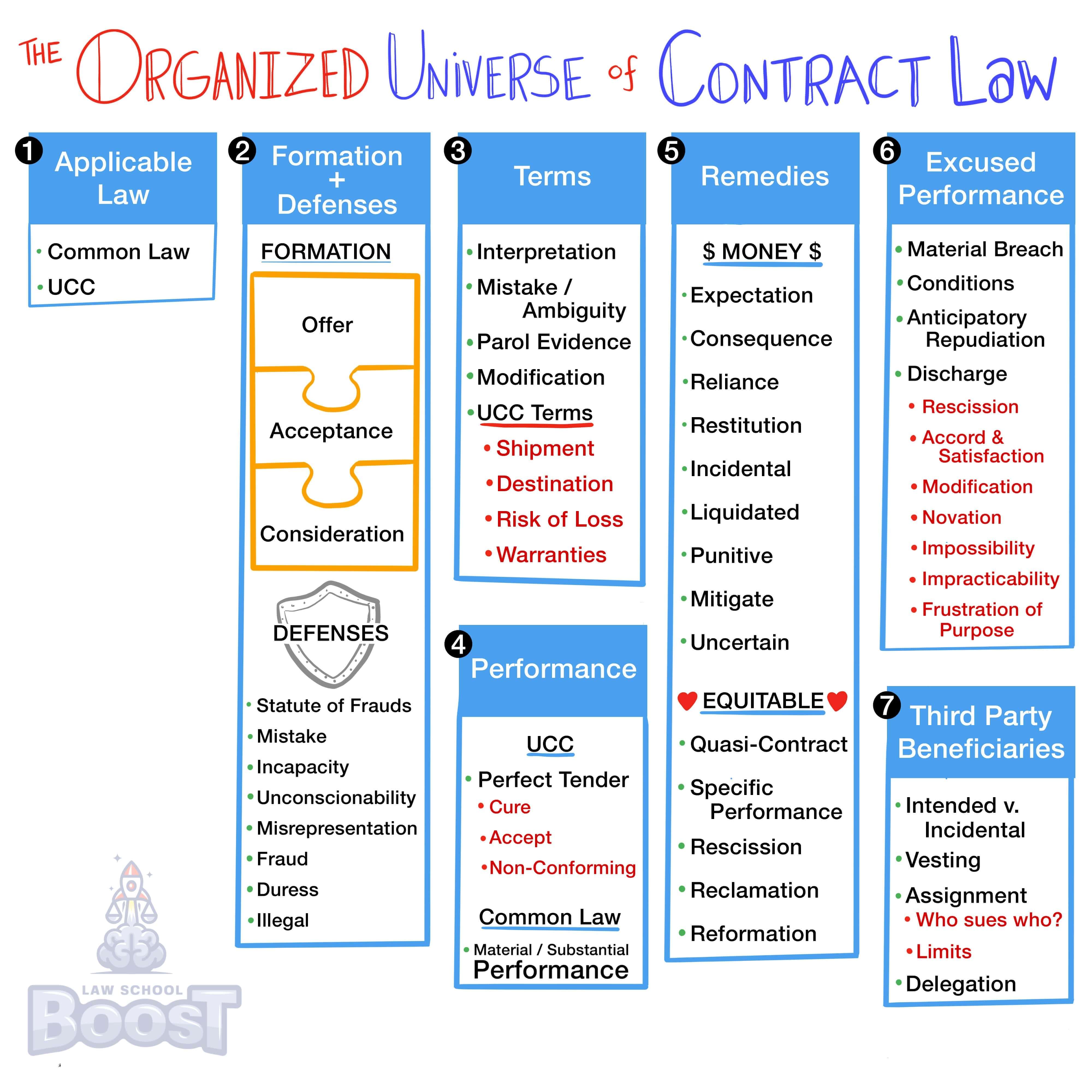
Contracts • Excuse of Non-Performance
K#127
Legal Definition
Under common law, a contract is divisible if: (1) each party's performance is divided into two or more parts; (2) each party has the same number of parts due; and (3) each part's performance is the quid pro quo of the other.
Under the UCC, divisible contracts are called installment contracts, where, the price may be demanded for each lot if it can be apportioned and there is no contrary intent.
Under the UCC, divisible contracts are called installment contracts, where, the price may be demanded for each lot if it can be apportioned and there is no contrary intent.
Plain English Explanation
Contracts are generally all or nothing. However, when a contract can be divided into specific, divisible units, the law will allow some sort of pro rata division of compensation related to the work that was done.
Hypothetical
Hypo 1: Bob builds house. Sam tells Bob he will pay him $1,000,000 to develop his land into a neighborhood of 10 $100,000 houses. After years of work, Bob has some health issues and only completes 6 of the 10 houses. Sam says, "Sorry, we agreed to 10 houses. You get nothing." Result: This is the perfect example of a divisible contract. Yes, the agreement technically requires Bob to build 10 houses, however, allowing Sam to keep the 6 completed houses would be unjust enrichment. Here, the court would allow Bob to sue Sam for $600,000 for the 6 $100,000 houses he completed.
Visual Aids
Related Concepts
How is performance affected when the subject matter of the contract is damaged or destroyed?
Under common law, is late performance a material breach?
Under common law, when is counter-performance excused?
Under common law, when may a breaching party recover in a divisible contract?
Under contract law, what is a modification?
What is excuse due to anticipatory repudiation?
What is excuse due to improper performance?
What is frustration of purpose?
What is impracticability?
What is the doctrine of impossibility?
What level of compliance is required to satisfy an express condition?
What options does the non-breaching party have in response to an anticipatory repudiation?